
Generations Give You Stories. Age Gives You Strategy.
Why age, not generations, should anchor your consumer strategy.


Marketers love labels. Few are stickier, or more seductive, than the generational kind: Boomers, Gen X, Millennials, Gen Z. They show up in pitch decks, brand strategy documents, and consumer research.
There is a reason for that. Generational labels are not meaningless. They can be powerful cultural shorthand. They capture shared experiences, create a common language, and sometimes spotlight real differences worth noting.
But labels are blunt instruments. They give a useful sketch, and they often oversimplify. If you want to understand how people behave, especially in categories like food, retail, or consumer goods, generations give you a broad story. Age gives you the strategy.
Where generations came from
Generations did not begin as marketing shorthand. Sociologists like Auguste Comte and Karl Mannheim used the concept to explain how age groups experience, and sometimes drive, social change.
Writing in 1923, Mannheim argued that people who come of age during the same historical moment often form a shared identity. Importantly, he distinguished between biology (parents and children) and timing (when people hit key life stages against the backdrop of major events).
Originally, generations were a tool for understanding how history shapes outlook. Over time, marketers repurposed the tool. In fast-changing societies, labeling cohorts looked like a simple way to segment consumers. Too simple.
Academics have pushed back for decades. Philip N. Cohen (University of Maryland) called generation labels constructs “imposed by survey researchers, journalists, or marketing firms” that encourage stereotyping. In 2023, Pew Research stopped using them altogether, arguing the harm outweighed the insight. And Louis Menand, writing in The New Yorker, put it bluntly: there is no evidence people within a generation are more similar to each other than to people in different ones.
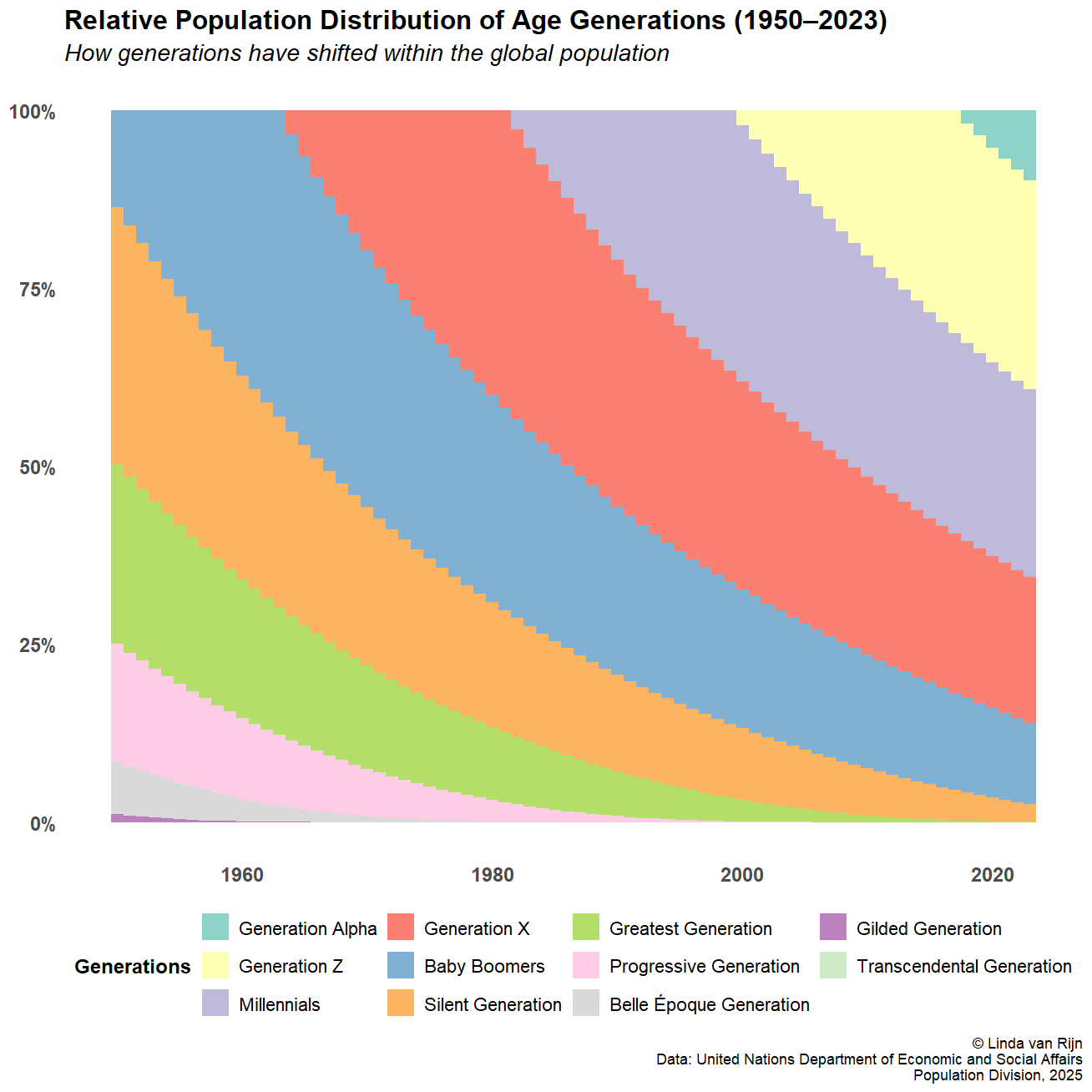
Why 20 years cannot mean one Thing
Generational labels usually cover 15–20 years. That is an eternity in terms of life stage and worldview.
Take Millennials. Born between 1981 and 1996, the oldest are in their mid-40s, the youngest still in their 20s. One group has mortgages and teenagers; the other is just getting established in work and housing. On paper, they belong to the same cohort. In reality, they are living very different lives.
A 44-year-old Millennial is likely closer in outlook to a 45-year-old Gen Xer than to a 28-year-old Millennial. Yet marketers treat them as one uniform block because a chart says so.

Why generational shorthand sticks
Generational shorthand sticks because it is easy. But easy does not make it accurate.
“Millennial” is still used to conjure a meme-loving, student-debt-laden 20-something. In truth, that “Millennial” is now pushing 40. Likewise, “Boomer” has become a catch-all for “anyone older than me,” flattening meaningful differences across decades of life.

With labels come stereotypes: entitled Millennials, cynical Gen Xers, tech-obsessed Gen Z. These clichés reduce people to caricatures and distract from real drivers of behavior. Once people internalize the stereotype, it can also shape how they see themselves. Generational shorthand can highlight fundamental shifts, but it also risks oversimplifying, turning differences into stereotypes.
The obsession with the youngest shoppers
Another recurring issue is the obsession with the newest generation to enter the market. As the Google Trends chart shows, interest in “Millennials” surged, only to be eclipsed by an even steeper spike in attention to “Gen Z.”
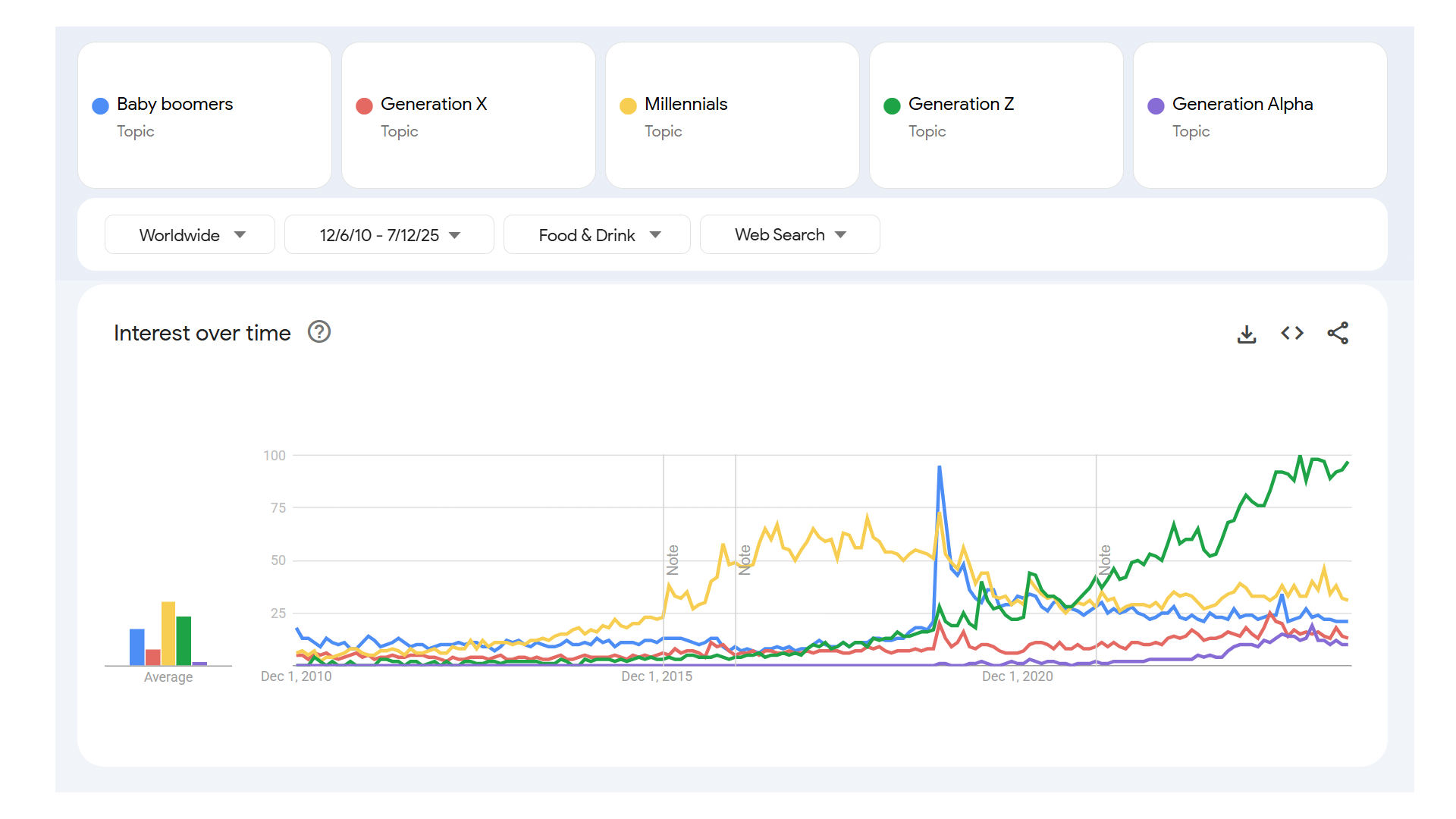
Marketers chase novelty, assuming the youngest group holds the key to future behaviors. This cycle distorts priorities.
Take alcohol consumption. A few years ago, headlines marveled: Why is Gen Z not drinking? Now, new studies claim that Gen Z is drinking after all. The truth may be simpler than the supposed generational riddle. Gen Z spans ages 13 to 28. The legal drinking age explains most of the gap, long before you need a cohort story.
Meanwhile, Gen Z makes up around 20% of the population but only about 4% of consumer value, as their earning power is still developing. Older generations, who hold far more disposable income, are too often overlooked, misclassified, or reduced to caricature.
The fixation on youth obscures the more stable and profitable insights tied to age itself.
The real problem: wrong assumptions
As Menand noted, generational categories are media constructions. They sound authoritative, but their limitations show quickly. The central idea that people in the same generation act alike, and differently from those in other generations, does not hold up. As a quick check, take one generational slide from your last deck and remake it with age bands and life stages. If the story shifts, you were looking at age or context, not an actual generational effect.
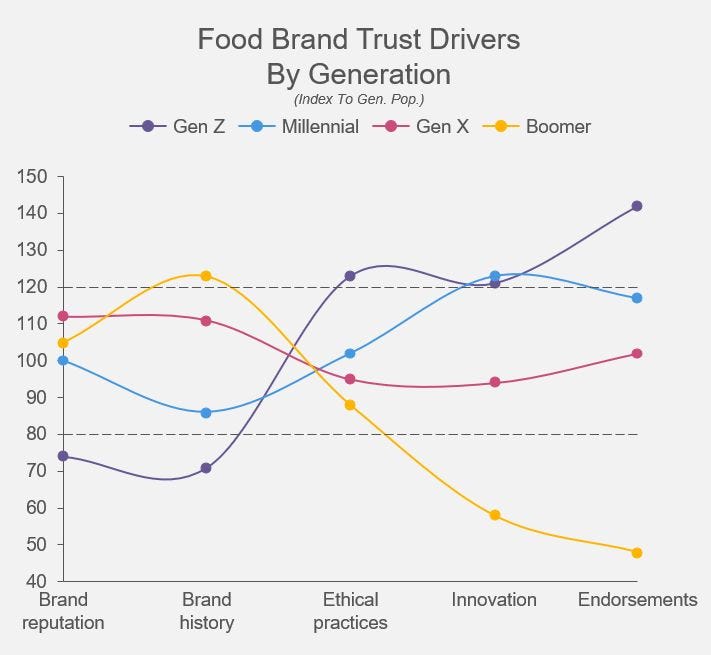
Behavior varies more reliably in relation to age, income, and context. A recent LinkedIn post compared how brand trust is shaped differently across generations, using a line graph to connect different “drivers” of brand trust.
That is a red flag. Those drivers are not points along a single spectrum. They are separate dimensions. Putting them on one line invites people to read meaning into the shape of the curve that is not really there.
The bigger problem was the interpretation. The analysis assumed that trust is shaped by generational identity. The more relevant question is whether other dynamics are at play. For example, younger consumers may emphasize innovation because they enjoy new experiences and have not yet formed long-term brand relationships. Older consumers may prioritize brand history and reputation because they have lived experience with what happens when brands change or disappear.
More subtly, the analysis ignored when people became shoppers. If you started shopping in the 1980s, you met a very different retail environment from someone starting in 2015. These cohort-specific experiences matter, and they are not captured by a generational label alone.
This points to a core methodological issue. Are we seeing the effects of age, or people being at different stages of life? Are we looking at period effects, where something happens to everyone at the same time, such as a pandemic or economic downturn? Or are the differences shaped by cohort, people who came of age in a similar cultural and economic context?
A simple diagnostic for any “generational” chart looks like this:
Are your variables actually on a spectrum, or are they separate attributes that should not be joined in a single line?
Are you sure you are looking at a generational effect, and not age or life stage differences?
What year did these shoppers first enter the category, and how might that cohort history be showing up in your data?
If your chart fails those checks, you do not have a clean generational insight. You have age, life stage, or cohort patterns wearing a generational label.
Demographer Norman Ryder noted decades ago that without tracking people over time, it is impossible to tell if you are looking at a generational trait, a short-term fad, or just something common to being 25. His work laid the foundation for age, period, and cohort analytics.

Why age beats generations
In my own research, I focused on age rather than generation. I wanted to understand how people change as they get older, and age proved a far better predictor than generation. A 26-year-old and a 44-year-old may both be Millennials, but their priorities, habits, and decisions reflect their age, not their label.
That is the challenge with generational categories: they stay fixed while the people inside them change. A 35-year-old Millennial today will be 45 in ten years. If you rely only on the label, you keep recalculating what it means. Age cuts through that. Age will not explain everything, but it usually explains more than a 20-year label.
It also forces sharper questions. What does a 32-year-old new parent need from a brand? What does a 68-year-old retiree want from a digital interface? These are the questions that actually drive strategy. In practice, I keep generations for cultural insight work and default to age, life stage, and cohort when I am building or critiquing a strategy.
Generations give us stories. Age gives us strategy.
Generational frameworks still matter. They show how cultural moments shape identity and how people see themselves in relation to others. They are useful for stories. I am not arguing that we should throw out generations. I am arguing for putting them in their place. Use generational language when you want to capture cultural mood or shared references. When you decide what to design, who to prioritize, and where to spend, you need age, life stage, and cohort instead.
If the goal is to understand consumer behavior, who buys what, when, and why, age is the sharper tool. Age moves, and people move with it. Generational labels stay fixed while the people within them change.
Age has limits, too. A 60-year-old marathon runner lives a very different life from a 60-year-old caregiver. Chronological age, set against psychology and context, is still a stronger starting point than a broad cohort label.
Use generations to frame the story. Use age to guide the strategy.